High-strength. Low-profile. No demolition.

Concrete reinforcement in Washington & Oregon

Cracked walls, deteriorated columns, failing beams — carbon fiber reinforcement stops the damage in place, often in a single day, without tearing anything out. Ten times stronger than steel. Less than 1/8 inch thick. 100% made in the USA.

Free · About 90 minutes · No obligation

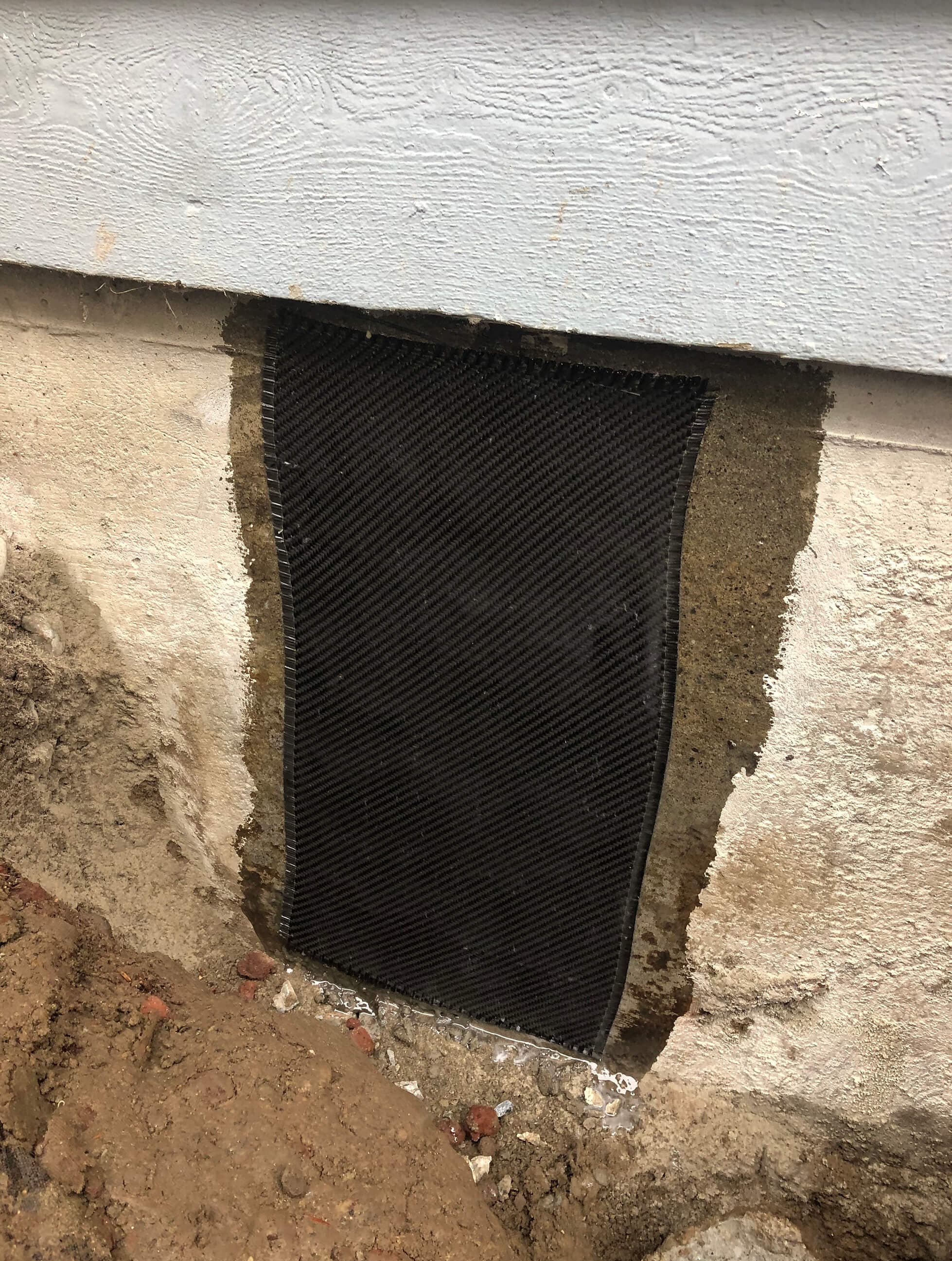
Carbon fiber reinforcement applied to a cracked stem wall

SRS-600UNI carbon fiber · ISO 9001:2015 certified

196,000 PSI
tensile strength
Since 2001
25+ years of experience
9
distinct CFRP applications
Lifetime
transferable warranty backed by a Warranty Trust

The problem

When concrete structures need reinforcement

Concrete is strong under compression — but it can fail in tension, shear, or bending. Once a crack forms, moisture reaches the rebar, corrosion begins, and the surrounding concrete deteriorates. Left unaddressed, structural capacity decreases.

Seismic gap

Pre-1977 infrastructure

Most concrete infrastructure built before 1977 lacks the lateral reinforcement required to resist seismic forces. In Washington and Oregon — both on active fault systems — this is a meaningful risk.

The modern fix

Carbon fiber reinforced polymer (CFRP)

CFRP bonds directly to the concrete surface, stops crack propagation, and restores or increases structural capacity — all without heavy demolition, extended downtime, or added structural weight.

Problems solved

What this fixes

  • Bowing walls
  • Stem wall failure
  • Cracked columns/beams
  • Wall openings
  • Crawlspace reinforcement

How we fix it

Nine concrete reinforcement applications

We use the SRS carbon fiber system — SRS-600UNI fabric with industrial-strength structural epoxy — across nine distinct applications.

Application 01

Bowing Wall Stabilization

SRS-600UNI straps conform to the wall surface and bond with epoxy that penetrates deep into the concrete — over 40,000 lbs of design tensile strength per strap permanently stops inward movement. Walls that have moved significantly get helical tieback anchors first; the carbon fiber then holds the wall between anchor points.

Application 02

Stem Wall Foundation Repair

Cracks in a foundation stem wall are an entry point for moisture and the start of a corrosion cycle in the embedded rebar. SRS carbon fiber applied with structural epoxy prevents further crack propagation, reinstates wall capacity, and provides waterproofing — and can be painted to match.

Application 03

Concrete Wall Crack Repair

Structural epoxy is injected into the crack itself, bonding the faces together. Carbon fiber fabric is then applied over the crack, adding tensile capacity and waterproofing so the crack does not reopen.

Application 04

Retaining Wall Reinforcement

For retaining walls that are tipping or rotating, carbon fiber stabilizes the wall face between tieback anchor points. Without anchors at the top, a reinforced-but-unrestrained wall continues to rotate as one stiff section — so we combine tiebacks (or soil nails) with CFRP.

Application 05

Column Strengthening

When a column's rebar is missing, damaged, or corroding, carbon fiber wrapping restores or increases load-carrying capacity. Columns wrap quickly, load almost immediately after cure, and add minimal weight. CFRP meets seismic code requirements for column ductility — pre-1977 columns are common candidates.

Application 06

Structural Wall Opening

Creating an opening in a structural wall requires re-routing the stress the removed rebar or tendons were carrying. CFRP transfers that stress around the opening and back to the remaining structure — far less invasive and less expensive than steel headers and temporary shoring.

Application 07

Beam Strengthening

CFRP applied to the tension face of an existing beam increases its flexural capacity — letting it carry heavier loads than it was originally designed for. The preferred method for re-purposing existing structures rather than rebuilding, proven to increase both flexural and shear capacity.

Application 08

Balcony Restoration

Balconies are particularly vulnerable to rebar corrosion from moisture and freeze-thaw cycles. Carbon fiber reinforcement restores structural capacity without the weight and disruption of full reconstruction.

Application 09

Crawlspace Footing Repair

Deteriorated crawlspace footings can be reinforced with CFRP wrapping where access limits traditional concrete repair methods — extending the life of the footing without excavation.

Bowing basement wall? See Basement & Wall Repair. Want the full carbon fiber story? See Carbon Fiber Solutions.

Real projects

Concrete reinforcement in action

Happy Valley, OR

Spring Mountain Elementary Wall

Carbon fiber (SRS-600/660) + tiebacks rescued a bowing school playground wall without full reconstruction.

Tacoma, WA

Support of Tacoma Home

A 1979 Tacoma home on a sloped lot settled 1.5". 4 helical + 3 driven piles plus carbon fiber straps stabilized the cracked stem wall.

4
helical piles
3
driven piles
1.5
settled (in)

See all projects →

The Warranty Trust

Reinforcement backed by a funded lifetime warranty

Qualifying SRS carbon fiber installations carry the Transferable Lifetime Warranty, backed by the Ram Jack National Limited Warranty Trust — a separately funded reserve. Coverage transfers to future owners at closing.

WarrantyTransferable Lifetime Warranty
Backed byRam Jack National Limited Warranty Trust
CoverageEvery qualifying helical and driven pile installation is protected for the life of the structure. The warranty transfers to future owners and is backed by a funded trust, so coverage survives even if the company can't service it directly.
Why it mattersMost contractors offer a warranty on paper. We're the only company in the PNW that backs it with guaranteed, secured funds.

FAQ

Concrete reinforcement questions, answered

How is carbon fiber reinforcement different from patching concrete?

Patching fills voids and stops surface deterioration. Carbon fiber reinforcement adds structural tensile capacity — it prevents the crack from reopening, stops further movement, and in many cases restores the element to more than its original design strength. They serve different purposes; often a full repair uses both.

Will the carbon fiber straps be visible?

The straps are less than 1/8 inch thick and conform to the wall or column surface. They can be painted or coated to match existing finishes, making them nearly invisible once completed.

Is carbon fiber really stronger than steel?

The SRS-600UNI carbon fiber fabric we use has a tensile strength of 196,000 PSI — approximately 10 times the tensile strength of mild steel. It's also lighter, non-corrosive, and does not add significant dead load to the structure.

Does this work on older pre-1977 buildings?

Yes, and those buildings are often the best candidates. Most pre-1977 concrete lacks adequate lateral reinforcement for seismic events. CFRP is a cost-effective, non-invasive way to bring older structures into compliance with current seismic requirements.

Your concrete structure deserves a real solution.

Free evaluation, honest assessment, no obligation. We'll tell you whether carbon fiber is the right fix — and if it is, we'll engineer it to last.

Free · About 90 minutes · No obligation