
Seattle, WA
Seattle Seawall & Bulkhead Repair
A 30-year-old Seattle bulkhead bowed at mid-span from soil loss. Helical tiebacks, SW-RP1 injection, and carbon fiber restored it for ~80% less than replacement.
~80% less
vs replacement
Seawall Repair Network® member · Puget Sound, lakes & coast
A cracking seawall or bowing bulkhead isn't just cosmetic — it's your property's last line of defense. We restore failing seawalls for about 80% less than full replacement, most repairs complete in a single day, and we never recommend tearing out what we can save.
Free · About 90 minutes · No obligation
Seawall Repair Network® member
The problem
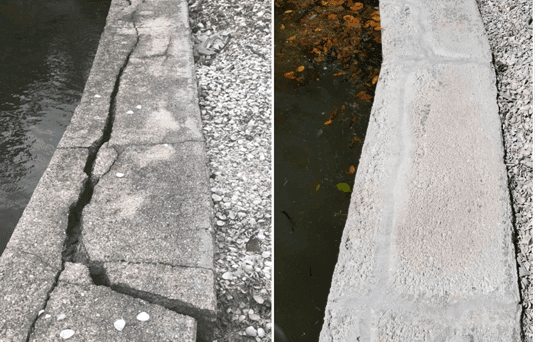
Seawalls and bulkheads hold back enormous lateral soil pressure — pressure that increases every time the water rises, waves strike, or soil becomes saturated. A seawall that shows any of these signs is under stress that won’t improve on its own.
A seawall that’s cracked lets water and soil migrate. As the soil behind the wall erodes, the structure loses its backing and the bowing accelerates. What’s a restoration today becomes a demolition-and-replacement tomorrow. The difference in cost is enormous.
How we fix it
As a proud member of the Seawall Repair Network®, Ram Jack West uses a proprietary system of advanced materials to restore the structural integrity of steel-reinforced concrete seawalls without removing or replacing the existing structure.
A high-strength injection resin pumped under pressure into cracks, voids, and the soil directly behind the wall. Once it permeates the soil and cures, it forms a mass stronger than crystalline bedrock — permanently stabilizing the backfill. Carries the official NSF seal of approval for contact with drinking water. Hydraulic cement, slurry, sodium silicate, and crushed seashells don't address the underlying soil instability — they're like patching a roof leak from the inside.
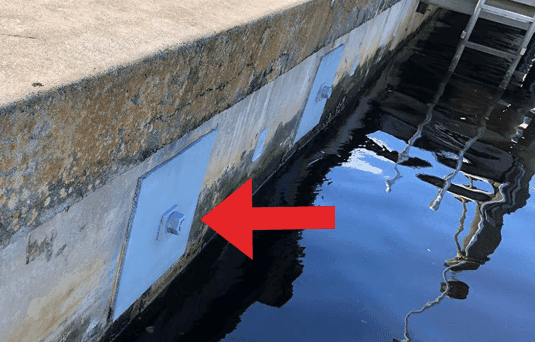
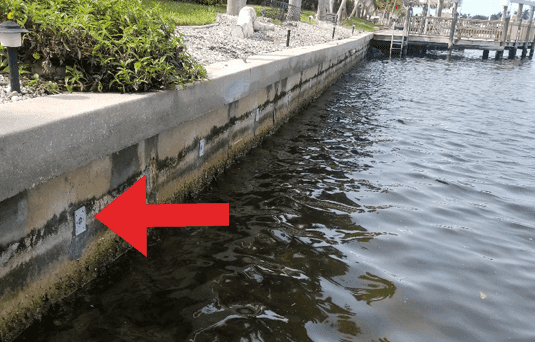
When a seawall needs structural restraint beyond soil injection, helical tieback anchors are installed through the wall and rotated into stable soil behind the eroded zone — transferring the lateral load from the wall face to competent soil while the SW-RP1 cures.
For surface cracking and panel damage, SRS carbon fiber straps (196,000 PSI tensile strength) are bonded across the cracks and to the wall face, restoring tensile capacity to the concrete and preventing further crack propagation.
Penetrates concrete as a vapor and deposits on rebar and mesh inside the wall, creating an insulating layer that halts ongoing corrosion. Applied early, it dramatically extends the remaining life of the embedded steel reinforcement.
Reduces concrete porosity, increases compressive strength, and raises internal pH to protect against rebar corrosion — counteracting the chemical degradation that salt water and soil contaminants cause over time.
The final sealing layer — a penetrating water repellent that makes the wall surface resistant to water, dirt, salt, and UV. Treated surfaces resist mold, staining, and discoloration.
From the waterline
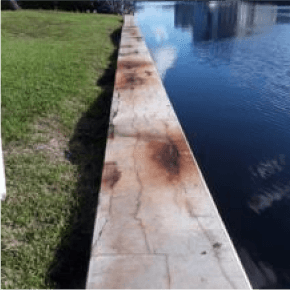
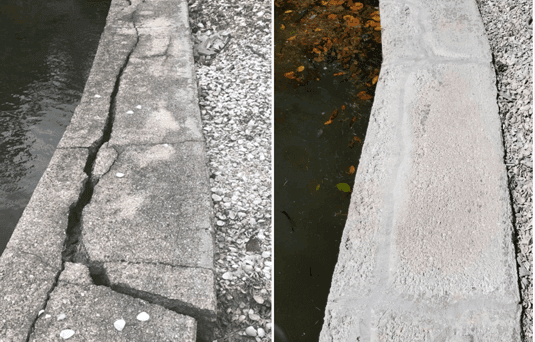
Real Ram Jack West seawall and bulkhead repairs across Puget Sound — no demolition, no shoreline tear-out.
Your choices
The most dangerous choice. The soil behind your wall is actively eroding, and the void grows with every wave and rain event. What's a restoration today becomes a demolition-and-replacement tomorrow.
Full replacement means heavy equipment on your shoreline — often requiring the removal of docks, boat lifts, and nearby structures. Months of construction, not days. It is sometimes the only option, but rarely.
Hydraulic cement, slurry, sodium silicate, crushed seashells — popular with contractors who don't have access to real seawall restoration technology. These materials don't address the soil behind the wall. The problem continues. You pay twice.
SW-RP1 stops the erosion. Tiebacks restore structural restraint. Carbon fiber repairs surface damage. SW-Prevent stops rebar corrosion. Most repairs complete in a single day, for ~80% less than replacement — with a Transferable Lifetime Warranty backed by a funded trust.
Real projects
Seattle, WA
A 30-year-old Seattle bulkhead bowed at mid-span from soil loss. Helical tiebacks, SW-RP1 injection, and carbon fiber restored it for ~80% less than replacement.
Gig Harbor, WA
A 115-ft Puget Sound seawall failing from soil loss: 11 helical tiebacks, 195 gal foam, drains, and 6 carbon fiber straps restored it.
Washington, DC
SW-RP1 grout injection created subsurface flood barriers for a D.C. drinking-water facility where sheet piles were impossible.
The Warranty Trust
Qualifying seawall and bulkhead restorations carry the Transferable Lifetime Warranty, backed by the Ram Jack National Limited Warranty Trust — a separately funded reserve. Coverage transfers to future owners at closing, protecting your waterfront property's value.
FAQ
The free evaluation is designed exactly for this. Our specialist will assess the extent of soil loss, the condition of the concrete and rebar, the degree of bowing, and the hydrostatic conditions specific to your shoreline. In most cases, restoration is possible. Where it isn't, we'll tell you that honestly — we're not going to recommend a repair that won't hold.
Most Seawall Repair Network® restorations complete in a single day. More complex jobs with significant tieback installations may take two to three days. Compare that to weeks or months for full replacement.
Yes. SW-RP1 carries the official NSF seal of approval for contact with drinking water — the highest standard for environmental safety in aquatic environments. All Seawall Repair Network® materials are designed for use in marine, lake, and river settings.
Get a second opinion — from us. Replacement is frequently recommended by contractors who don't have restoration technology. The Seawall Repair Network® system exists precisely because most failing seawalls don't need to be torn out. The evaluation is free.
Free, no pressure — and if restoration is the right call, we'll restore it for about 80% less than replacement.
Free · About 90 minutes · No obligation