
McMinnville, OR
Patton Middle School Seismic Retrofit
270 helical piles to 65 ft seismically retrofit a 1972 school — finished ahead of schedule without interrupting the school year.
270
piles
65
depth (ft)
2
months
Cascadia. Seattle Fault. Nisqually. Your home needs to be ready.
The Pacific Northwest sits above one of the most active seismic zones in North America. If your home predates modern seismic codes — or sits on fill, soft river-valley soil, or a liquefaction-prone site — a helical pile retrofit meaningfully improves how it performs when the next big one hits.
Free · About 90 minutes · No obligation
UC San Diego shake-table + PEER liquefaction testing
The problem
The risk isn’t theoretical. The 2001 Nisqually earthquake (M6.8) caused $2 billion in damage across the Puget Sound region. The Cascadia Subduction Zone — capable of a M9.0 — has ruptured roughly every 200–500 years and is overdue. The Seattle Fault runs directly beneath the city.
A home that isn’t properly connected to stable soil during a major seismic event will move with the soil. If that soil liquefies — turns from solid ground into fluid-like material under shaking — the structure above can sink, tilt, or collapse.
How we fix it
A helical pile’s slender shaft dampens the destructive harmonic resonance that earthquakes transmit from soil to structure. More importantly, helical piles bypass weak or liquefiable soil entirely — torqued to confirmed depth in competent strata below the problem zone. When the soil above them moves, the structure above the piles largely does not.
270 helical piles installed to 65 feet seismically retrofit a 1972 school in McMinnville, Oregon — completed ahead of schedule in two months, without interrupting the school year. Oregon mandates that all public buildings meet seismic code. Washington is following. Many pre-code residential structures have no equivalent requirement — but the fault lines don’t care about code mandates.
The engineering proof
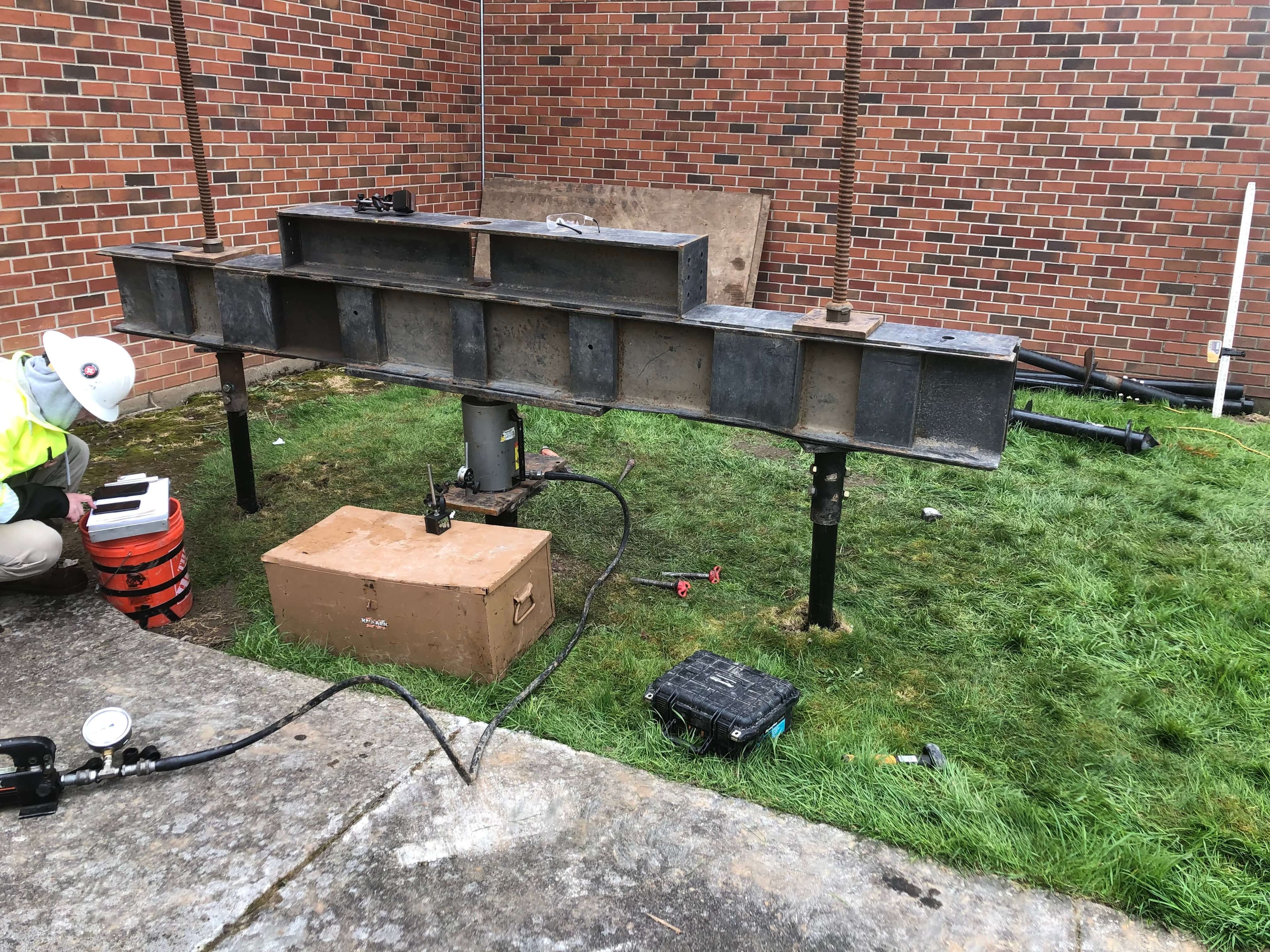
Ram Jack sponsored a large-scale shake-table test at the University of California, San Diego — the first test of its kind to quantify the seismic response of helical piles in dry sand conditions. Seven earthquakes were simulated. Zero failures. A second test, funded by the Pacific Earthquake Engineering Research Center (PEER), simulated an earthquake on a structure in a liquefaction zone — the first such test performed in the United States.
11 inches of differential settlement in a seismic event is catastrophic — likely structural collapse. 0.5 inches means people survive. That difference is what a helical pile retrofit provides.
Real projects
McMinnville, OR
270 helical piles to 65 ft seismically retrofit a 1972 school — finished ahead of schedule without interrupting the school year.
Tacoma, WA
When helical piles couldn't reach torque in stiff soil, Ram Jack value-engineered a micropile solution with the geotechnical engineer for this civic seismic upgrade.
Anchorage, AK
After the 2018 M7.1 quake liquefied soil under an Anchorage home, 63 helical piles recovered 3" and damp future seismic forces.
Eugene, OR
390 micropiles to 30 ft met strict seismic code on poor soil — validated by a full load-test program.
Sparks, NV
Ram Jack designed proprietary micropile brackets to anchor 14 piles into rocky soil for a GM distribution-center seismic retrofit — showcasing in-house engineering.
The Warranty Trust
Qualifying helical pile seismic retrofit installations carry the Transferable Lifetime Warranty, backed by the Ram Jack National Limited Warranty Trust — a separately funded reserve. The warranty transfers at closing. The UCSD and PEER test data gives you the engineering proof. The Warranty Trust gives you the financial backstop.
FAQ
If your home was built before the 1990s, sits on fill or soft soil near water or a river valley, or has an unbraced cripple wall — a free evaluation will tell you honestly where it stands. Many older Seattle homes have never been connected to stable bearing soil. A retrofit doesn't mean your home is unsafe; it means you're taking a real seismic risk seriously.
Traditional seismic retrofits address the connection between the house and the foundation — important, but they don't address what happens when the soil itself moves. Helical piles bypass weak soil entirely, anchoring the structure to competent strata below the problem zone. The UCSD and PEER tests quantify the difference: 0.5 inches vs 11 inches of movement under identical seismic loads.
Yes, and this is often the most efficient approach. If your home has existing settlement AND seismic vulnerability, we can design a combined scope — piles that both lift and stabilize the existing foundation and provide the seismic connection to stable soil. One mobilization.
Helical piles install cleanly — no vibration, no spoils, no large excavation. Most installations happen from the interior crawlspace or around the perimeter with minimal disruption to landscaping.
Free seismic evaluation — we'll tell you honestly whether your home needs a retrofit and exactly what it would involve.
Free · About 90 minutes · No obligation